
The party had twelve people in a two-bedroom apartment, a playlist nobody hated, and enough food that there was no reason to leave early. By 9:30, half the room was rearranged into three separate conversations: the people who already knew each other, the people who were politely waiting for someone to pull them in, and the host, who was circulating between both groups and running out of things to say.
This is not a failure of the guest list or the host or the food. It's a structural problem with how parties work. Unless something actively pulls a mixed group together, social gravity will always sort people back into existing clusters.
A well-placed question game is that something. Not a formal game night setup — a format light enough that you can run it standing up with drinks in hand, flexible enough to survive someone leaving to refresh their glass halfway through, and interesting enough that people want to stay in it rather than drift to their phones.
The difference is that party questions need to work differently than the question games most people know. This covers what works, when to use it, and the questions that have actually held a room together.
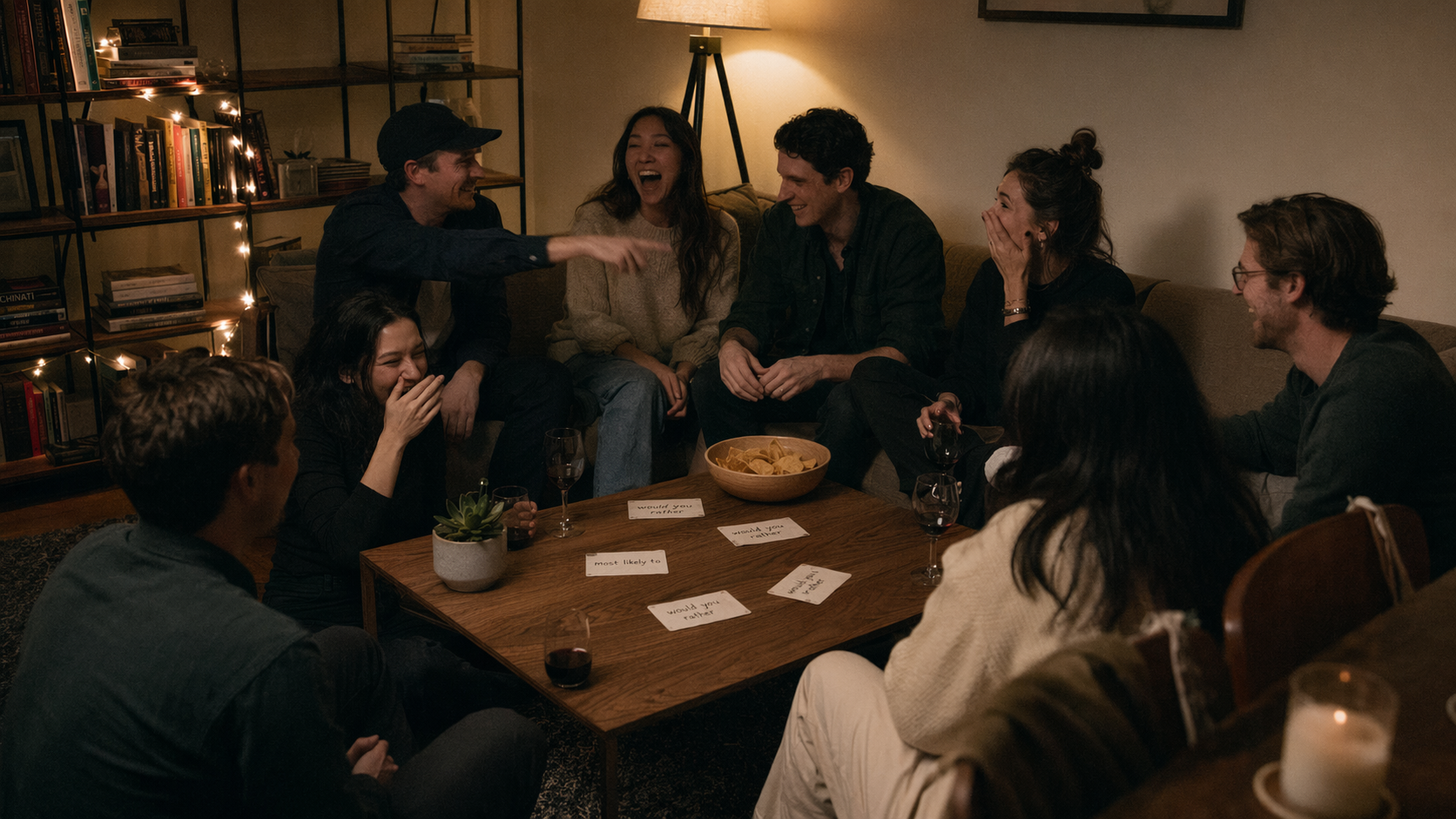
Why Parties Are Structurally Harder Than Game Nights
The conditions that make a small group question game great — everyone seated, low noise, shared attention — don't exist at most parties. Someone is always arriving or leaving. Background music makes it hard to hear across the room. The energy level is higher and the tolerance for slow games is lower.
Most question game guides are written for quiet living rooms with four to six people who already know each other. That's a different context entirely from a birthday party with twenty attendees spanning three different social circles.
Robert Waldinger, director of the Harvard Study of Adult Development — the longest-running study of happiness ever conducted — identified that the quality of relationships determines wellbeing more than wealth, fame, or any other factor they measured. Not the quantity of connections: the quality. A party where people leave knowing two new people a little better is genuinely valuable. A party where everyone talks only to the people they already knew is a wasted evening.
The question is how to create quality moments in a chaotic setting.
Waldinger's research is the cleanest argument for why a party that actually creates connection is worth engineering deliberately.
Read the Room Before You Pick the Format
A party isn't a single moment — it moves through phases, and the right game for 8 PM is wrong for 10:30 PM. The biggest mistake hosts make is running a slow, personal question game on cold arrivals, or trying to restart a high-energy crowd-shouter after the group has naturally shrunk to eight quiet people who've been talking for an hour.
The signal to look for: how many people are already talking to people they didn't know before tonight? If the answer is almost none, start with something that gives strangers a reason to talk to each other. If the answer is most people, you can go somewhere more personal.
Party Formats Compared
Not every question game survives a party. Here's how the most common formats actually hold up in real conditions.
| Format | Best group size | Works at noise? | Setup needed | Intensity | Time to run |
|---|---|---|---|---|---|
| Quick-answer openers | Any | Yes | None | Low | 5–10 min |
| Most likely to (party edition) | 6–15 | Yes | None | Low–medium | 10–20 min |
| This or that debate | 4–10 | Moderate | None | Medium | 10–20 min |
| Never have I ever | 4–12 | Moderate | Drinks or tokens | Medium | 15–25 min |
| Hot seat (one question, everyone answers) | 5–10 | No | Quiet room | Medium–high | 10 min |
| Truth or dare | 4–10 | No | Quiet, seated | High | 20–45 min |
The general rule: games that require everyone to hear a single person talking don't work at peak party volume. Save truth or dare and hot seat for when the room has naturally gotten quieter — usually after 11 PM when the crowd has thinned.
First Arrivals: Questions to Break the Initial Silence
These are for the phase where people are still meeting. The goal isn't a deep conversation — it's giving strangers a single interesting thing to say to each other. Fast, low-stakes, easy to overhear and join.
- What's the last thing you watched that you immediately needed to recommend to someone?
- What's a food combination you'll defend forever despite the looks people give you?
- If your commute were a movie genre, what would it be?
- What's something you've become unreasonably good at due to boredom?
- What's the most recent thing you genuinely changed your mind about?
- What's a phrase or word that someone in your life uses that has completely colonized your vocabulary?
- What's your current "I'll start Monday" project?
- What's the most recent rabbit hole you fell down online?
- What's something you've owned for over five years that you'd describe as essential?
- What's the strangest compliment anyone has ever paid you?
- What's a skill that sounds useful in theory but you've never once needed?
- What's a movie or show everyone seems to love that you simply cannot get into?
- What's the most recent thing you bought on impulse that actually turned out to be worth it?
- What's a childhood belief you held with complete conviction that turned out to be completely wrong?
- What's a song that immediately transports you somewhere specific?
- If you had to attribute your current career to one unlikely event or decision, what would it be?
- What's the last thing you were completely wrong about and had to admit it?
- What's a product or service you've become weirdly loyal to?
- What's something small you did recently that you're quietly proud of?
- What's the best bad-weather activity you know?
These work as conversation starters rather than rounds. Throw one into the air when a cluster of people looks like they've run out of things to say. You don't need to be the host to do this.
Peak Energy: Questions That Work Shouted Across the Room
Most Likely To is the one format that scales up instead of down. At full volume, with a large mixed group, it creates exactly the kind of chaos a party needs — arguments, accusations, surprised laughter, and a dozen follow-up conversations.
The format is simple: read the question, everyone points at the same time (or shouts a name simultaneously on a count of three), then anyone who got multiple votes has to either defend themselves or explain the group's logic.
- Most likely to fall asleep in a meeting and wake up right as their name gets called.
- Most likely to have an extremely strong opinion about something completely inconsequential.
- Most likely to accidentally become internet famous for the wrong reason.
- Most likely to own the exact same item in four different colors.
- Most likely to forget which car they drove to an event and have to walk the whole lot.
- Most likely to be deeply, personally offended by a piece of fictional media.
- Most likely to have a playlist with a suspiciously specific title.
- Most likely to answer every question with another question.
- Most likely to give a 12-minute explanation of a show instead of just saying the title.
- Most likely to have an extremely well-organized drawer, somewhere, no one has seen.
- Most likely to discover they've been pronouncing a common word wrong for twenty years.
- Most likely to still be at the party when the host is doing dishes.
- Most likely to have a strong opinion about font choices.
- Most likely to get emotionally attached to an inanimate object and then feel bad throwing it away.
- Most likely to know the exact calorie count of whatever they're eating right now.
- Most likely to have the most unhinged Notes app of anyone in this room.
- Most likely to describe every flight they've ever been on unprompted.
- Most likely to have seen a documentary that has fundamentally changed how they think about an everyday thing.
- Most likely to have a secret talent nobody at this party knows about.
- Most likely to give the worst directions but with tremendous confidence.
Keep the pace fast. Two seconds of debate per person, three maximum. If someone gets defensive, that's the game working.
Mid-Party: Quick This-or-That to Keep the Energy Moving
These work in the transition window between peak energy and the later, quieter phase. Good for groups of six to ten. Both options have legitimate arguments — that's the point. The question isn't what someone picks; it's the explanation.
- Summer birthday or winter birthday?
- Knowing spoilers in advance or going in completely blind?
- Be unreasonably early or chronically late?
- One long vacation or several short trips?
- Live in a city you love for five years, then move — or a city you like for the rest of your life?
- Know exactly when you're going to die, or not know at all?
- Always have to sing your words instead of speaking, or always have to dance while walking?
- Perfect memory or perfect ability to forget anything you chose?
- Win an argument that nobody else will ever know you won, or lose an argument publicly that you were right about?
- Be famous in your field but unknown outside it, or slightly famous everywhere?
- Be ten years ahead of everyone on one specific thing, or five years ahead on everything?
- Read everyone's texts or have everyone read yours?
- Have extremely good taste but no ability to act on it, or average taste but the ability to execute everything perfectly?
- Know every language but speak each one with a terrible accent, or speak one language perfectly?
- Be the smartest person in every room for a week, or the funniest?
The way to run this at a party: pose it to the whole room, get a show of hands, then ask the side that's outnumbered to defend itself. Outnumbered sides always argue harder.
When It Gets Quieter: Questions for the Group That's Still There at Midnight
The people still at the party at midnight are a self-selected group. They want to keep talking. This is when you can go somewhere real.
- What's something you've done recently that past-you would find surprising?
- What's a belief you grew up with that you've quietly abandoned?
- What's something you genuinely envy about someone in this room?
- What was the best decision you made in your twenties? The worst?
- What's something you're more afraid of now than you were five years ago?
- What's something you've been putting off that you know you're going to have to deal with eventually?
- What's the version of your life that almost happened?
- What's something you've worked hard to become better at, even though no one else would notice?
- What's an opinion you hold that you know isn't popular in this room?
- What's something you've done in the last year that you're genuinely proud of, that wasn't about work?
- What's something a stranger once said to you that has stuck with you?
- What's a relationship in your life you've been neglecting and you know it?
- What's something you've stopped caring about in the last few years that used to feel urgent?
- Who do you think has the most different life from the one they expected when they were twenty?
- What's a thing you want to do before you're too old to do it — that you haven't done yet?
Don't rush these. One question, let it breathe, wait for the secondary responses after the first person answers. The second and third answers are usually better than the first.
The One Thing That Keeps Any Party Game Going
Every format above shares one design feature: the answer to the question is not the point. The conversation after the answer is.
"Most likely to have a Notes app nobody should see" produces an answer in two seconds. What follows it — the explanation, the challenge, the cross-examination — is what makes it work. The job of the question is to give everyone something specific to react to.
That's different from how people normally approach question games, which is to treat the answers as the content and the questions as a delivery mechanism. Flip it. The answers are the ignition. What matters is where the room goes after.
Running It Without Making It Feel Like a School Activity
A party game that feels hosted — like an activity someone is running for the group — creates passive participants rather than people genuinely playing. The goal is to introduce the format and then step back enough that it runs itself.
The way to do that:
Start mid-conversation. Don't announce a game. Just ask a question to the nearest cluster and let the format reveal itself. "Actually, here — everyone point at the same time: most likely to still be here when I'm cleaning up." If it lands, it spreads.
Let wrong answers be wrong. Someone who picks an unexpected person for a Most Likely To question is more valuable to the room than someone who picks the obvious answer. The disagreement is the point.
Quit while it's good. Stop after fifteen minutes, not twenty-five. The instinct is to run a game until it's fully exhausted. The better move is to stop while people are still into it — they'll want to come back to it later, which means the conversations it started keep running on their own.
Let it die if it dies. Some groups don't want a game. If there's already a great conversation happening, a question game will interrupt it. Read the room. The questions are a tool, not the goal.
For Specific Party Types
Not all parties are the same context, and what works at a birthday dinner is wrong for a housewarming with forty people.
| Party type | Best formats | Questions to lead with | Formats to avoid |
|---|---|---|---|
| Birthday (close friends) | Hot seat, truth or dare, deep questions | "What's the weirdest compliment you've ever received?" | Most Likely To (overused at birthdays) |
| Housewarming (mixed strangers) | Quick openers, Most Likely To | "What's something you've become unreasonably good at?" | Anything that requires a quiet room |
| Work party | This or that (low stakes), quick openers | "What's your most unpopular food opinion?" | Anything personal or confessional |
| House party (20+ people) | Most Likely To (rotating crowds), quick openers | "Most likely to..." run across multiple clusters | Long-format games |
| Dinner party (6–8) | This or that, deep questions, Never Have I Ever | "What's the version of your life that almost happened?" | Loud crowd-shouters |
| End-of-year / team celebration | This or that, surface-level Most Likely To | "What's something about this year that surprised you?" | Anything too personal |
The column to pay attention to: "Formats to avoid." Every game that goes wrong at a party goes wrong because it was used in the wrong context, not because the questions were bad.